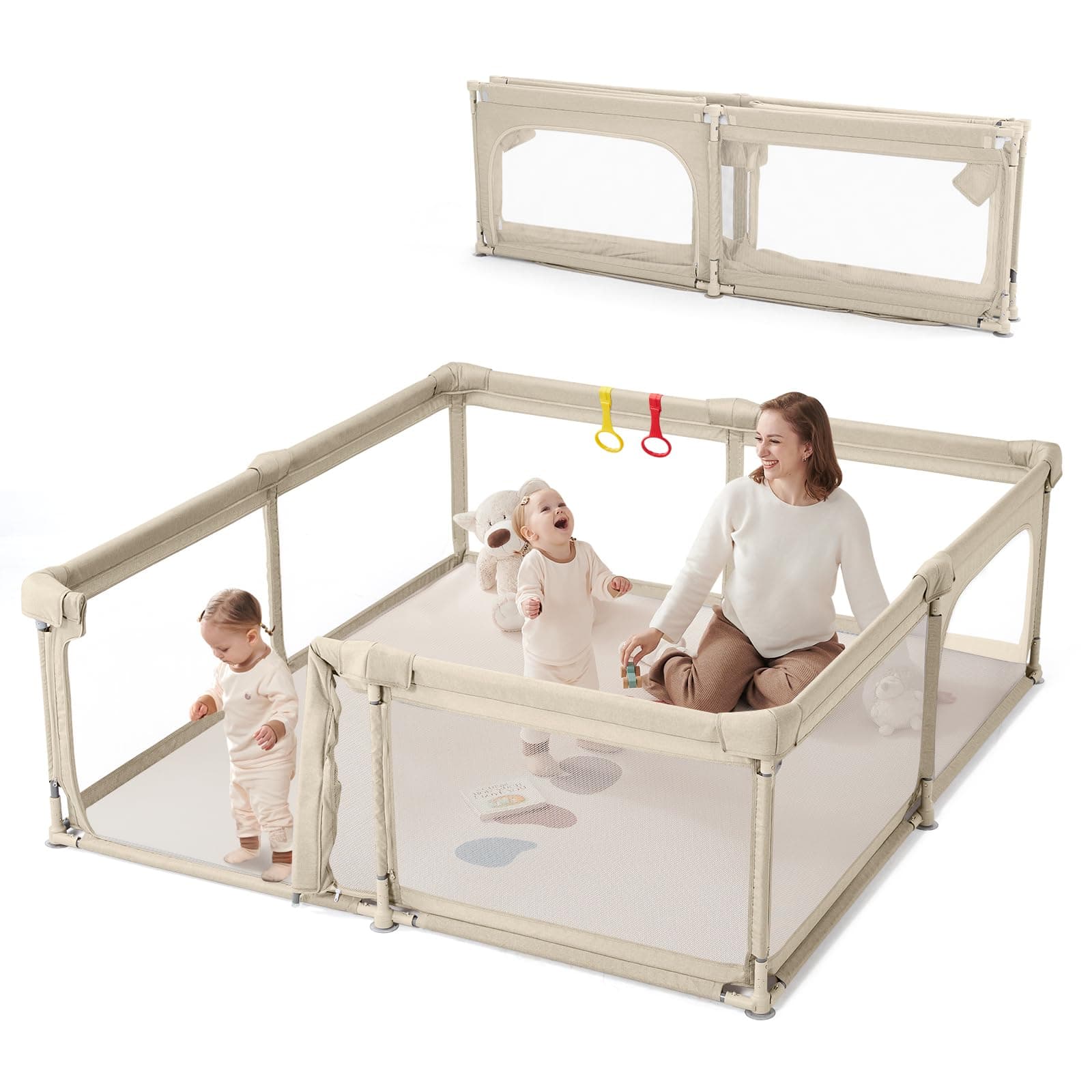
Twin Playpens: One Big, Two Small, or Fence the Room?
Three ways to contain two mobile babies. The right choice depends on your floor plan, your budget, and how much your twins cooperate with each other.
Around month 6 to 8, your twins start moving. Rolling becomes crawling, crawling becomes cruising, and your living room becomes a hazard zone. You need a containment strategy. The three options are one large playpen, two small playpens, or fencing off a room. Each has tradeoffs.
When you need containment (and when you do not)#
Containment becomes necessary when your twins can move independently but cannot yet understand the word "no." This is usually 6 to 14 months. Before 6 months, a play mat on the floor is enough. After 14 to 18 months, most toddlers can be redirected verbally (with effort). The playpen window is roughly 8 months long.
If you have a small, fully baby-proofed apartment with no stairs and no exposed cables, you may not need a playpen at all. The room itself is the pen. Most homes, however, have at least one hazard zone that cannot be fully proofed.
Option 1: One large playpen#
A single large play yard (6 to 8 panels) that holds both twins with room to crawl, roll, and play.
- Pros: twins interact with each other, only one setup to manage, more floor space per baby than two small pens.
- Cons: takes up significant room space (a 6-panel pen is about 5 by 5 feet), both babies fuss at the same time if one is unhappy, harder to separate them when they irritate each other.
- Best for: homes with a dedicated play area or large living room. Twin parents who want to contain both babies in one view.
Popular options: Toddleroo by North States Superyard (6 to 8 panels, about $80 to $120), Regalo 192-Inch Super Wide Gate and Play Yard (configurable, about $70 to $100), Skip Hop Playview Expandable Enclosure ($100 to $130).
Option 2: Two small playpens#
Two separate, smaller play yards, each holding one baby.
- Pros: you can separate twins when one is napping and the other is playing, or when they are bothering each other. Independent space for each baby.
- Cons: doubles the floor space consumed, doubles the cost, and two contained babies in two locations means you are splitting your attention between two spots.
- Best for: twins who are on very different schedules (one naps while the other plays) or who physically overwhelm each other in shared space.
This is less common than parents expect. Most twin parents start with two small pens and consolidate to one large one within a month, because supervising two separate zones is harder than supervising one.
Option 3: Fence off a room#
Instead of putting the babies inside a pen, put the hazards outside a fence. Use baby gates or modular panel fences to block off a section of the living room or a whole room.
- Pros: maximum play space for both twins, feels less confining, the fenced area can include furniture and floor mats. Scales as they grow.
- Cons: requires a room that can be fully proofed within the fenced zone (outlets covered, cords hidden, no heavy pull-down-able furniture). Initial setup takes more effort.
- Best for: homes with an open-plan living room or a dedicated playroom. The most popular long-term solution for twin parents.
The fenced-room approach costs about the same as a large playpen ($80 to $150 in gate panels) but gives 3 to 5 times the floor space. The catch is that the entire fenced zone must be safe, not just the pen interior.
The hybrid approach#
Many twin parents use a combination: a fenced play zone for daytime supervised play, plus one small pack-and-play for when you need to contain one baby safely while you deal with the other (diaper change, phone call, bathroom break). The pack-and-play is not the primary play space. It is the emergency containment device.
What stops working#
- Mesh-sided playpens that twins can push over together. Two babies leaning on the same panel will topple lightweight pens. Use panel-style pens with feet, not pop-up mesh.
- Pens that are too small. A 4-panel pen for two mobile babies is a recipe for frustration. Go 6 panels minimum.
- Pens placed on hard floors without a mat. Crawling and falling on hardwood is unpleasant. A foam play mat inside the pen is not optional.
What we would do#
Start with a fenced-off section of the main living area using modular gate panels. Add a foam play mat. Keep one pack-and-play as a containment backup. Skip two separate small pens unless your twins have radically different schedules. The goal is supervised, safe floor time with maximum crawling space. Twins learn from each other, and they learn best when they have room to move.
Related reading#
FAQ
- Do twins need one big playpen or two small ones?
- One big one, or better, a fenced-off room section. Most parents who start with two small pens consolidate within a month, because supervising two zones is harder than one. Two pens only earn their space when twins run on very different schedules or physically overwhelm each other.
- When do twins need a playpen?
- Roughly months 6 to 14: mobile enough to get into trouble, too young to be redirected verbally. Before 6 months a play mat covers it; after 14 to 18 months redirection starts working. If your apartment is small and fully proofed, the room itself can be the pen.
- Is fencing off a room better than a playpen for twins?
- Usually. Panel fencing costs about the same as a large play yard (80 to 150 dollars) but gives 3 to 5 times the floor space, and twins learn best with room to move. The catch: everything inside the fence must be proofed, outlets covered, cords hidden, furniture anchored. Keep one pack-n-play as emergency containment for one baby while you deal with the other.
- What playpens fail with twins?
- Pop-up mesh pens (two babies leaning on the same panel topple them; use panel pens with feet), anything smaller than 6 panels (a 4-panel pen with two mobile babies is a frustration box), and bare pens on hardwood. A foam mat inside is not optional when two crawlers are falling on it.
Keep reading
Related guides
Do I Need Two
Do I Need a Twin Stroller, or Two Singles?
One twin stroller, almost always. Two singles plus an extra hand is not the answer most twin parents think it is.
Sep 11, 2026
Do I Need Two
Twin Feeding Pillow: Do You Need the Specialized One?
A twin nursing pillow is one of the few twin-specific products that genuinely earns its shelf space. But not everyone needs one. Here is how to decide.
Sep 10, 2026
Do I Need Two
Do I Need Two Baby Bathtubs for Twins?
Almost never. One tub plus a sink, or one tub plus a sturdy bath seat, handles both babies without the second-tub clutter.
Sep 10, 2026