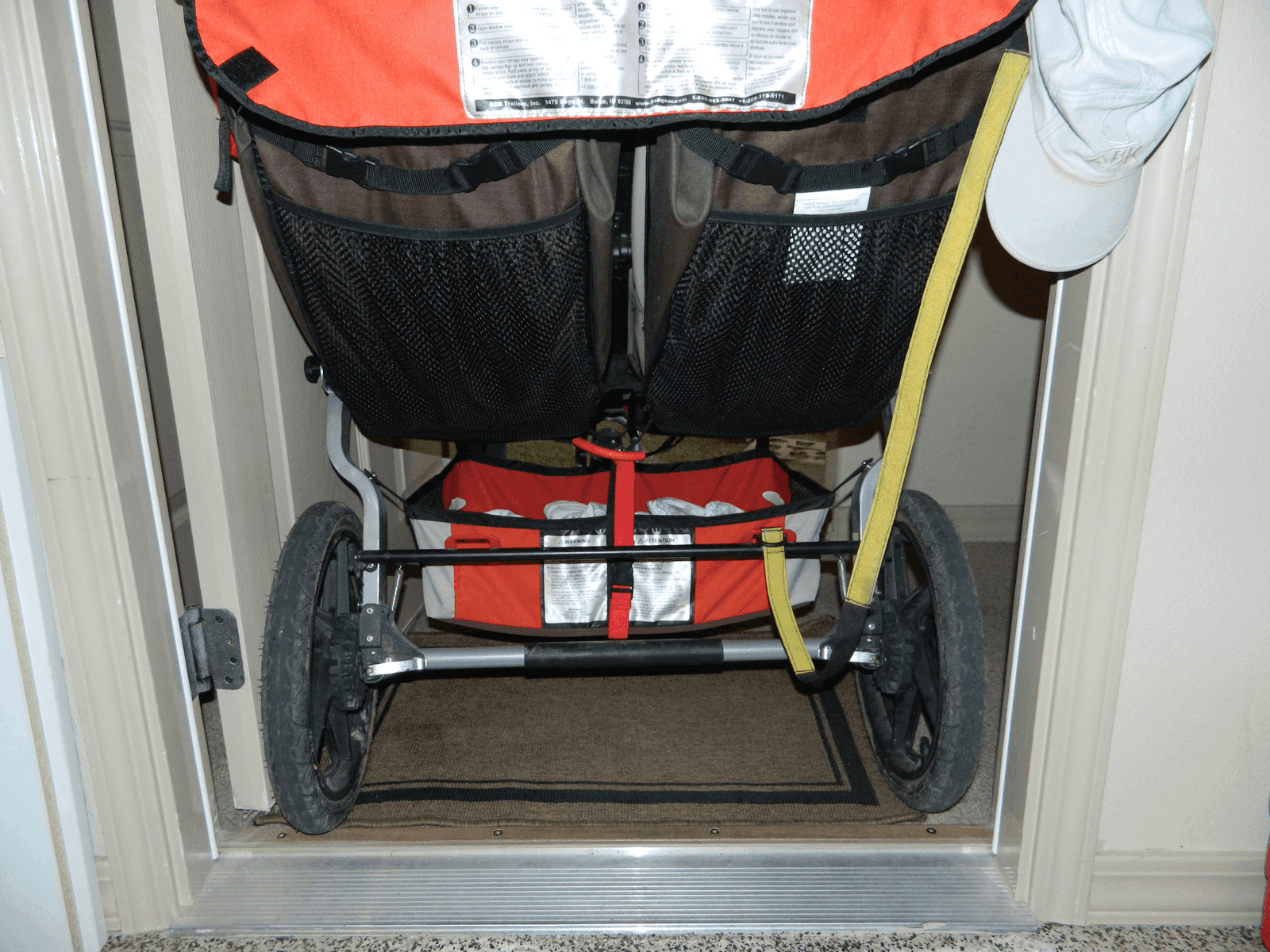
The Twin Stroller Doorway Test: Will It Fit Your Life?
Before you buy a double stroller, measure your doorways, your elevator, and your trunk. Most strollers fail at least one of those three tests.
The best twin stroller is the one that fits through your front door. This sounds obvious, but most stroller reviews focus on suspension, canopy fabric, and cup holder placement. None of that matters if the stroller physically cannot enter your apartment.
The three measurements that decide everything#
Before you open a single product page, get a tape measure and write down these three numbers:
- Your narrowest doorway. This is usually the bathroom or the apartment front door, not the building entrance. Standard US interior doors are 30 to 32 inches. Older European apartments can be 26 to 28 inches. Measure the actual clear opening, not the door frame.
- Your elevator interior width. If you use one, measure the inside wall to wall. Many residential elevators are 36 inches wide, which seems generous until you add a parent and a diaper bag.
- Your car trunk depth and width. Fold a large blanket to the approximate size of a folded stroller and test whether it leaves room for a diaper bag and groceries. You will always be carrying more than just the stroller.
Write these three numbers on a sticky note. Tape it to your laptop. Every stroller you consider must pass all three tests.
Side-by-side vs tandem: a width decision, not a preference#
The side-by-side vs tandem debate is not about style. It is about width.
- Side-by-side strollers are 28 to 34 inches wide. Most are around 30 to 31 inches. They fit standard 32-inch doorways with very little clearance. They do not fit 28-inch European doors or narrow elevator openings.
- Tandem (inline) strollers are 22 to 26 inches wide. They fit almost any doorway. The tradeoff is length: tandem strollers are longer, harder to turn in tight spaces, and heavier.
If your narrowest door is under 30 inches, tandem is your only realistic option. If all your doors are 32 inches or wider, both formats work and you can choose based on other factors.
Real measurements for popular twin strollers#
These are manufacturer-stated widths. Actual clearance depends on wheel angle and accessories. Add half an inch to be safe.
- Bugaboo Donkey 5 (side-by-side): 28.5 inches. One of the narrower side-by-sides.
- BabyJogger City Mini GT2 Double: 29.75 inches. Tight through 30-inch doors but possible.
- Mockingbird Single-to-Double: 30 inches. Right at the standard door width.
- UPPAbaby Vista V2 (tandem with rumble seat): 25.7 inches. Fits everywhere, but long.
- BabyJogger City Select 2 (tandem): 25.5 inches. Narrow and maneuverable.
- Joovy Twin Roo+ (car-seat frame): 30 inches. Transitional for months 0 to 6.
The elevator test nobody runs#
Elevator fit is not just about width. You also need to turn the stroller to get in and out. A 30-inch stroller in a 36-inch elevator requires a 3-point turn with a running baby commentary from bystanders. Practice this before buying.
Tandem strollers enter elevators front-first and back out. Side-by-sides enter at an angle and require more interior space to maneuver. If your elevator is tight, tandem wins on elevator logistics alone.
The trunk test#
Folded stroller dimensions matter as much as open dimensions. Key numbers:
- Sedan trunk (Honda Civic, Toyota Corolla): about 13 to 15 cubic feet. A compact-fold tandem fits. Most side-by-side folds do not, unless they fold very flat.
- Compact SUV trunk (RAV4, CR-V): about 25 to 30 cubic feet. Almost any double stroller fits, with room left over.
- Hatchback (VW Golf, Mazda3): about 18 to 22 cubic feet. Borderline. Check the specific stroller fold dimensions against your trunk depth.
One-hand fold matters more for twin parents than for singleton parents, because your other hand is holding a baby. Test the fold mechanism in the store. If it requires two hands and a knee, skip it.
The decision framework#
Use this flowchart:
- Narrowest door under 28 inches? Tandem stroller or no stroller (babywear instead).
- Narrowest door 28 to 30 inches? Narrow side-by-side (Bugaboo Donkey) or tandem.
- Narrowest door 30 to 32 inches? Most side-by-sides fit. Choose by trunk and weight.
- Narrowest door over 32 inches? Any double stroller works. Choose by terrain, weight, and budget.
- No car? Skip the trunk test. Optimize for weight and one-hand fold instead.
- No elevator? Optimize for weight above all else. You will carry it up stairs.
What we would do#
Measure first, shop second. Eliminate every stroller that fails any one of your three numbers. The surviving list is usually short, which makes the final choice much easier. Do not fall in love with a stroller that cannot physically enter your home.
Related reading#
FAQ
- What measurements should you take before buying a twin stroller?
- Three numbers: your narrowest doorway (often the bathroom or apartment door, not the building entrance), your elevator's interior width if you use one, and your trunk's depth and width. Write them on a sticky note and eliminate every stroller that fails any one of the three.
- Will a side-by-side double stroller fit through a normal door?
- Barely, sometimes. Side-by-sides run 28 to 34 inches wide, mostly around 30 to 31, so they squeeze through standard 32-inch doorways with little clearance and do not fit 28-inch European doors. Tandem strollers at 22 to 26 inches fit almost any doorway; the trade is length and turning radius.
- Which double strollers fit in a sedan trunk?
- Compact-fold tandems, generally. A Civic or Corolla trunk (13 to 15 cubic feet) fits a compact tandem fold but defeats most side-by-side folds. Compact SUVs swallow almost anything. Also test the fold mechanism in the store: if it needs two hands and a knee, skip it, because your other hand will be holding a baby.
- How do you choose a stroller if you have no car or no elevator?
- No car: skip the trunk test entirely and optimize for weight and a one-hand fold. No elevator: optimize for weight above all, because you will carry the stroller up the stairs. And if your narrowest door is under 28 inches, it is tandem or babywearing; no side-by-side survives that opening.
Keep reading
Related guides
Gear Guides
UPPAbaby Vista V2 vs Baby Jogger City Select 2 for Twins
Both are inline twin strollers that clear an apartment door. The Vista is nicer to push, fold, and resell. The City Select 2 gives twins two equal seats for less money.
Sep 12, 2026
Gear Guides
Best Twin Bassinets for a Shared Bedroom
Bedside bassinets, dual bassinets, and what fits when you and the babies share a room for the first six months.
Sep 12, 2026
Gear Guides
Bugaboo Donkey 5 Twin vs UPPAbaby Vista V2: Side-by-Side or Inline
The Donkey puts twins next to each other in equal seats at about 28 inches wide. The Vista stacks them at about 26 inches for far less money. Doorways and budget decide it.
Sep 11, 2026