Twin Childcare: Daycare vs Nanny vs Nanny Share vs Au Pair
Childcare is the single largest twin expense. Here is what each option actually costs, when each makes sense, and the hidden costs most guides skip.
Childcare for twins is the financial conversation that hits hardest. With a singleton, daycare is a line item. With twins, it is often the largest household expense, bigger than rent in many US cities. The math is fundamentally different from one baby, and the options available to twin parents have different tradeoffs than singleton parents face.
The twin math: why childcare is different#
With one baby, childcare is roughly $1,000 to $2,500 per month depending on region and type. With twins, you do not simply double it. Some options scale linearly (daycare: yes, you pay per child). Others scale sublinearly (nanny: same person watches both babies for a modest premium). Understanding which costs scale and which do not is the key to the whole decision.
- Daycare: scales nearly 2x. Two spots, two tuitions. Some centers offer 5 to 10% sibling discounts, but the savings are modest.
- Nanny: scales about 1.2 to 1.4x. One person, both babies. The hourly rate goes up for two children, but not double.
- Nanny share: scales about 0.6 to 0.8x per family. You split one nanny's salary with another family.
- Au pair: flat cost regardless of number of children (up to the program's limit). Twins do not cost more than one child.
Daycare for twins#
Daycare (center-based) is the most structured option. Your babies go to a facility with trained staff, a set schedule, and other children.
- Monthly cost (US, 2026): $1,300 to $3,000 per child. For twins: $2,600 to $6,000 per month. Metro areas (NYC, SF, Boston, DC) skew toward the top. Midwest and South skew lower.
- Sibling discounts: 5 to 10% off the second child at most centers. Some offer nothing. Always ask.
- Waitlists: infant spots are the hardest to get. For twins, you need two infant spots simultaneously, which can double the waitlist time. Get on lists early, ideally in the second trimester.
- Pros: socialization, structured schedule, professional staff, regulated environments, does not depend on one person's health.
- Cons: expensive for two, rigid hours, frequent illness in the first year (expect your twins to be sick every 2 to 3 weeks initially), closures on holidays.
A note on illness: daycare babies get sick more often in year one. Twin daycare babies bring home viruses at roughly the same rate, but both get sick simultaneously, which means double the sick days and double the backup-care problem.
Nanny for twins#
A nanny comes to your home and cares for your children exclusively. For twins, this is often the most practical option in the first year.
- Monthly cost (US, 2026): $2,500 to $4,500 for full-time (40 to 50 hours per week). Rates vary by city, experience, and whether you include benefits.
- Nanny tax and payroll: if you hire legally (and you should), add 10 to 15% for employer-side taxes, workers' comp, and payroll service. Services like HomePay or Poppins simplify this.
- Pros: exclusive attention for your babies, flexible schedule, no commute for the kids, fewer illnesses than daycare, customized care.
- Cons: depends entirely on one person (if they are sick, you have no care), more expensive per month than most daycare, managing an employee relationship, no built-in socialization.
The nanny math often favors twins. Two daycare spots at $2,000 each is $4,000. A nanny at $3,500 is cheaper and offers more flexibility. This crossover is why nannies are disproportionately popular with twin families.
Nanny share for twins#
A nanny share means your nanny also watches another family's child (or children), and you split the cost. This is increasingly popular in cities with high childcare costs.
- Monthly cost per family (US, 2026): $1,800 to $3,000. The nanny earns more total (split between two families), while each family pays less than they would solo.
- How it works: typically one family hosts (their home), and the other family drops off. Some shares rotate homes weekly.
- Pros: significantly cheaper than a solo nanny, built-in playmate for babies, socialization benefits.
- Cons: scheduling conflicts between families, different parenting philosophies can clash, your twins plus another baby means the nanny has three children (some nannies will not take this on), host family bears more disruption.
With twins, the nanny share equation is trickier. Most nanny shares involve one child per family. Bringing two into the share means the nanny is watching three, which commands a higher rate and fewer nannies are willing. Some twin families do a share where the other family also has one child (3:1 ratio), but this requires a nanny comfortable with three under two.
Au pair for twins#
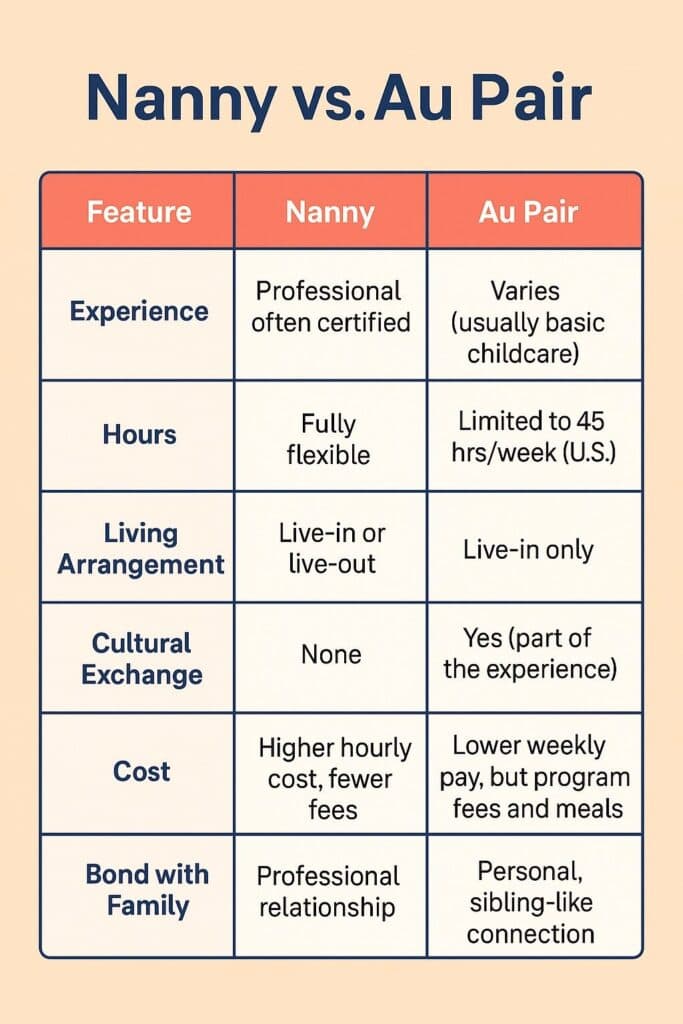
An au pair is a young person (usually 18 to 26) from another country who lives with your family and provides childcare in exchange for room, board, a stipend, and a cultural exchange experience. In the US, au pairs are managed through State Department-designated agencies.
- Monthly cost (US, 2026): roughly $1,500 to $2,000 all-in. This includes the agency fee (spread monthly), the weekly stipend ($195.75 per week minimum in 2026), room and board, and education contribution.
- Hours: up to 45 hours per week, up to 10 hours per day. Flexible scheduling within those limits.
- Pros: affordable for twins (flat cost, not per-child), live-in means no commute issues, flexible hours, cultural enrichment, young and energetic.
- Cons: you need a private room for the au pair, 12-month commitment (with possible rematch), variable experience level, managing a household member who is also your employee, limited childcare training compared to a career nanny.
Au pairs are a strong twin option that many families overlook. The per-child economics are unbeatable. The main barriers are having a spare room and being comfortable with a live-in arrangement.
When each option makes sense#
Daycare makes sense when:
- Both parents work predictable 8-to-5 hours.
- Your budget can absorb $2,600 to $6,000 per month.
- You value the structure and socialization of a center.
- You want redundancy (if one caregiver is sick, the center still operates).
A nanny makes sense when:
- Your schedule is unpredictable or involves travel.
- Two daycare spots would cost more than a nanny.
- Your twins are under 12 months and you want them home.
- You can manage the payroll and employment relationship.
A nanny share makes sense when:
- You want nanny-level care at a lower price.
- You know another family with similar-aged children and compatible values.
- Your twins can handle a 3:1 or 4:1 child-to-nanny ratio (usually works better after 12 months).
An au pair makes sense when:
- You have a spare bedroom.
- You want flexible, affordable, live-in care.
- You are comfortable mentoring a young adult from another country.
- Your twins are past the newborn stage (most agencies require babies to be at least 3 months).
Hidden costs most guides skip#
- Backup care. When your nanny or au pair is sick, you need a plan. Backup nanny agencies charge $25 to $45 per hour. Budget for 5 to 10 backup days per year.
- Sick days for daycare twins. Your twins will get sent home from daycare regularly in the first year. Each send-home means a lost workday for one parent. Value this at your hourly rate.
- Holiday closures. Most daycares close for 10 to 15 days per year beyond weekends. Nannies expect paid holidays (typically 5 to 10). Au pairs get 2 weeks paid vacation.
- Transition costs. Switching nannies or daycare centers is expensive in time and emotional disruption. Factor in retention when choosing.
- Gear duplication. Daycare may require you to provide cribs, car seats for emergencies, extra clothes, diapers, and formula. For twins, double it all.
The big-picture numbers#
Annual childcare cost for twins (US, 2026 estimates, full-time care):
- Daycare: $31,000 to $72,000 per year.
- Nanny: $30,000 to $54,000 per year (plus taxes and benefits).
- Nanny share: $22,000 to $36,000 per year.
- Au pair: $18,000 to $24,000 per year.
- One parent stays home: $0 direct cost, but $40,000 to $120,000 in lost income depending on the parent's salary.
For many twin families, childcare in the first two years costs more than a year of college will. This is not sustainable long-term, and most families make a transition (to preschool, to part-time, to one parent adjusting work) by year two or three. The infant years are the expensive years.
Related reading#
FAQ
- What is the cheapest childcare option for twins?
- Per the 2026 US numbers: au pair (18,000 to 24,000 dollars a year, flat cost regardless of child count), then nanny share (22,000 to 36,000), nanny (30,000 to 54,000 plus taxes), then daycare (31,000 to 72,000, since you pay two full tuitions). The key is which costs scale per child and which do not.
- Is a nanny cheaper than daycare for twins?
- Often, yes, and this is the twin-specific crossover. Daycare scales nearly 2x (two spots, two tuitions, maybe a 5 to 10 percent sibling discount), while a nanny scales about 1.2 to 1.4x since one person watches both. Two 2,000-dollar daycare spots lose to a 3,500-dollar nanny, with more flexibility.
- What hidden childcare costs do twin parents miss?
- Backup care when the nanny is sick (25 to 45 dollars an hour, budget 5 to 10 days a year), simultaneous sick-day send-homes from daycare (twins get sick together), 10 to 15 days of daycare holiday closures, employer-side nanny taxes of 10 to 15 percent, and doubled gear the daycare requires you to supply.
- When should twins go on daycare waitlists?
- Second trimester. Infant spots are the scarcest, and twins need two of them at the same center at the same time, which can double the waitlist time. Get on multiple lists early and always ask about sibling discounts, even though they are modest.
Keep reading
Related guides
Survival
Should Twins Be in the Same Class or Separate? What the Research Says
Every twin parent faces this question by age 4 or 5. Schools often have a default policy. The research says the answer depends on your specific twins, not a blanket rule.
Sep 11, 2026
Survival
NICU Survival Guide for Twin Parents
About half of twins spend time in the NICU. It is scary, it is common, and it usually ends well. Here is what to expect, what to pack, and how to get through it.
Sep 11, 2026
Survival
Combination Feeding Twins: The Practical Guide to Breast Plus Bottle
Most twin parents end up combination feeding. Not because they planned to, but because the math demands it. Here is how to do it well, protect your supply, and stop feeling guilty about bottles.
Sep 11, 2026