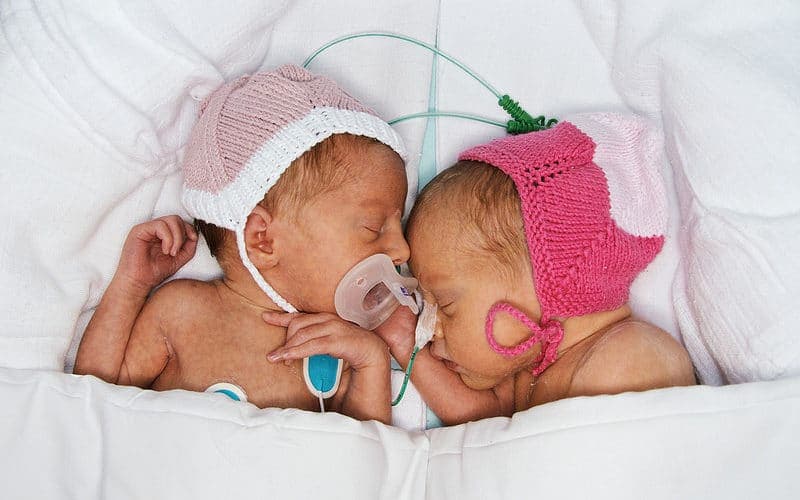
NICU Survival Guide for Twin Parents
About half of twins spend time in the NICU. It is scary, it is common, and it usually ends well. Here is what to expect, what to pack, and how to get through it.
If you are reading this before your twins arrive, good. Knowing what the NICU looks like in advance makes the experience less disorienting. If you are reading this from a NICU waiting room right now, here is the most important thing first: most NICU stays for twins are short (days to weeks, not months), and most twins come home healthy. The NICU exists because it works.
Why twins end up in the NICU#
About 50 to 60% of twins spend at least some time in the NICU. The number is high because twins arrive early, and early arrivals need monitoring. The most common reasons:
- Prematurity. The average twin delivery is 36 weeks. Babies born before 37 weeks often need help with temperature regulation, feeding, or breathing.
- Low birth weight. Twins tend to be smaller than singletons at the same gestational age. Below about 5 pounds (2,500 grams), monitoring is standard.
- Respiratory support. Lungs mature late. Twins born at 34 to 36 weeks may need brief oxygen support or CPAP.
- Feeding difficulty. Premature babies often cannot coordinate suck-swallow-breathe until 34 to 35 weeks. Tube feeding bridges the gap.
- Jaundice. Common in premature babies, easily treated with phototherapy, rarely serious.
Most of these reasons resolve on their own with time and monitoring. The NICU is not fixing something broken. It is providing support while your babies finish developing.
The first 24 to 48 hours#
The first day in the NICU is overwhelming. Here is what to expect so the overwhelm has a structure.
- You will likely not hold your babies immediately if they need respiratory support. This is hard. It is temporary.
- A neonatologist will explain what each baby needs and the expected timeline. Ask them to write it down or repeat it. You will not remember details from this conversation.
- Monitors will alarm constantly. Most alarms are benign (a sensor slipped, a baby moved). Nurses respond to alarms calmly because most are not emergencies. Let the nurses' body language guide your own.
- You can usually touch your babies through the isolette portholes. Skin contact (kangaroo care) often starts within 24 to 48 hours if babies are stable.
- If you delivered via C-section, you will be managing your own recovery simultaneously. Do not skip your own pain medication to stay at the bedside. You cannot help your babies if you are in acute pain.
Visiting logistics with two babies#
NICU visiting policies vary by hospital, but most allow parents 24-hour access. The logistics of visiting two babies, especially if they are in different pods or rooms, take planning.
- Ask if your twins can be placed near each other. Most NICUs accommodate this when space allows.
- Create a visiting schedule with your partner. You do not both need to be there at every moment. One parent resting while the other visits is a better strategy than both parents exhausted at the bedside.
- Bring a notebook or use an app. Write down what each nurse tells you about each baby. Names of nurses, feeding volumes, weight changes, test results. You will want this information later and you will not remember it.
- Ask about pumping rooms and storage. If you are pumping, the NICU should have a dedicated pump room and labeled storage for your milk.
Kangaroo care with two babies
Skin-to-skin contact (kangaroo care) is one of the most evidence-backed interventions for premature babies. It stabilizes heart rate, temperature, and breathing, and it helps with bonding.
With twins, you can hold one baby at a time for kangaroo care, or both simultaneously if they are small enough and you have support positioning them. Most NICU nurses will help you set up tandem kangaroo care when both babies are stable enough. Ask for it. It is one of the few things in the NICU that feels like parenting rather than waiting.
What to pack for the NICU (not a regular hospital bag)#
Your NICU bag is different from a delivery hospital bag. You will be visiting daily, not staying in a room. Pack for repeated trips.
- Comfortable shoes. You will walk hospital hallways many times a day.
- A phone charger (long cable). You will spend hours sitting next to isolettes.
- Snacks that do not crumble. Hospital cafeterias close. Granola bars, nuts, dried fruit.
- A water bottle. Dehydration is real, especially if pumping.
- A robe or zip-front shirt for kangaroo care. You need easy chest access without removing everything.
- Photos or a small item from home for each isolette. Many NICUs welcome a family photo taped to the isolette.
- Headphones. For pumping sessions, for waiting, for the moments you need to be somewhere else mentally.
- A small notebook and pen. For tracking what nurses tell you.
Leave behind: large bags of baby clothes (your babies will be in NICU-provided onesies or just diapers), visitors' gifts that take up space, and anxiety-driven Amazon orders. The NICU provides everything your babies need medically. You are providing presence.
NICU-specific gear to have ready at home#
When your babies come home, they may be smaller or younger (adjusted age) than typical newborns. Have these ready:
- Preemie-sized clothes. Regular newborn clothes will be too big for babies under 6 pounds. A few preemie onesies and sleep sacks are worth having.
- A room thermometer. NICU babies are used to controlled temperatures. Keep the nursery at 68 to 72 degrees Fahrenheit (20 to 22 Celsius) for the first weeks.
- Your regular twin gear, but set up early. Car seats installed, cribs made, feeding station stocked. You may get discharge news with 24 hours' notice.
- A baby scale (optional but helpful). NICU parents are used to tracking weight daily. A home scale can ease the transition from "the nurses are monitoring" to "we are monitoring."
Feeding in the NICU#
NICU feeding is its own world. Your babies may start on IV nutrition, move to tube feeding (gavage), then to bottle or breast as they develop the suck-swallow-breathe coordination.
- Pump early and often. If you want to provide breast milk, start pumping within 6 hours of delivery. Even tiny amounts of colostrum matter for NICU babies.
- NICU-grade pumps are available at the hospital. Use them. They are stronger and gentler than consumer pumps.
- Label everything. NICU milk storage is strict. Your milk, labeled with your name, baby's name, date, and time.
- Do not feel guilty if you cannot pump enough. NICU babies often receive donor milk or formula supplementation. This is normal and does not mean you have failed.
When one baby is in the NICU and the other is not#
This happens more often than people expect. One twin meets discharge criteria, the other needs more time. The split is emotionally brutal. You are simultaneously a NICU parent and a home parent, pulled in two directions.
- Set up a rotation. One parent at home with the discharged baby, one at the NICU, then switch.
- Take the discharged baby to the NICU for visits if the hospital allows it. Keeping the twins in proximity helps everyone.
- Do not feel guilty about the baby you are not with at any given moment. Both babies are being cared for. That is what matters.
- The NICU baby will come home. The separation is temporary. Most split-discharge gaps are 3 to 14 days.
Staggered discharge: what to expect#
Staggered discharge (one baby comes home before the other) is common with twins. Criteria for discharge usually include:
- Maintaining body temperature in an open crib.
- Feeding consistently by mouth (breast or bottle) without tube supplementation.
- No significant apnea or bradycardia events for a set period (usually 5 to 7 days).
- Steady weight gain.
One twin often hits these milestones days or weeks before the other. This is normal and does not predict long-term differences. The second baby catches up.
The emotional side#
We are not going to sugarcoat this. The NICU is scary. Even a short stay, even when everything goes well, is an emotional event that many twin parents carry for months afterward.
- It is normal to feel helpless. You are handing your babies' care to strangers. The strangers are very good at this, but the feeling is real.
- It is normal to feel guilty, especially if you had a complicated delivery or if you feel your body "should have" carried them longer. Your body grew two humans. That is extraordinary.
- It is normal to feel numb. Some parents don't cry in the NICU. They cry weeks later, at home, holding a healthy baby. The timeline of processing is yours.
- It is normal to feel angry at other parents with "easy" births. That anger fades. Give it time.
Ask the NICU social worker about support resources. Most hospitals have NICU parent support groups, mental health referrals, and peer mentors. Use them. You are not weak for needing help. You are in a hard situation.
How it usually ends#
Most twin NICU stays are short. The median for twins born at 34 to 36 weeks is 7 to 14 days. For twins born at 32 to 34 weeks, it is 2 to 4 weeks. For very premature twins (under 32 weeks), it is longer, but outcomes have improved dramatically in the last decade.
When you bring your last baby home, the NICU chapter closes. Your house will be chaotic, your sleep will be destroyed, and your babies will be fine. The NICU did its job. Now it is your turn.
Related reading#
FAQ
- How common is NICU time for twins?
- About 50 to 60 percent of twins spend at least some time in the NICU, mostly because twins arrive early and early arrivals need support: temperature regulation, feeding coordination, sometimes brief breathing help, and jaundice treatment. Most stays are short and most twins come home healthy.
- How long do twins usually stay in the NICU?
- The median for twins born at 34 to 36 weeks is 7 to 14 days; at 32 to 34 weeks, 2 to 4 weeks; under 32 weeks, longer, though outcomes have improved dramatically. Discharge usually requires holding temperature in an open crib, full oral feeding, no apnea events for 5 to 7 days, and steady weight gain.
- What should you pack for NICU visits?
- Pack for repeated day trips, not a hospital stay: comfortable shoes, a long phone cable, snacks that do not crumble, a water bottle, a zip-front shirt for kangaroo care, headphones, and a notebook for what each nurse tells you. Skip baby clothes; the NICU provides what the babies need. You are providing presence.
- What happens when one twin comes home before the other?
- Staggered discharge is common and the gap is usually 3 to 14 days. Set up a rotation (one parent home, one at the NICU, then swap), bring the discharged twin for visits if the hospital allows, and drop the guilt about whichever baby you are not with. Both are being cared for, and the second baby catches up.
Keep reading
Related guides
Survival
Should Twins Be in the Same Class or Separate? What the Research Says
Every twin parent faces this question by age 4 or 5. Schools often have a default policy. The research says the answer depends on your specific twins, not a blanket rule.
Sep 11, 2026
Survival
Twin Childcare: Daycare vs Nanny vs Nanny Share vs Au Pair
Childcare is the single largest twin expense. Here is what each option actually costs, when each makes sense, and the hidden costs most guides skip.
Sep 11, 2026
Survival
Combination Feeding Twins: The Practical Guide to Breast Plus Bottle
Most twin parents end up combination feeding. Not because they planned to, but because the math demands it. Here is how to do it well, protect your supply, and stop feeling guilty about bottles.
Sep 11, 2026