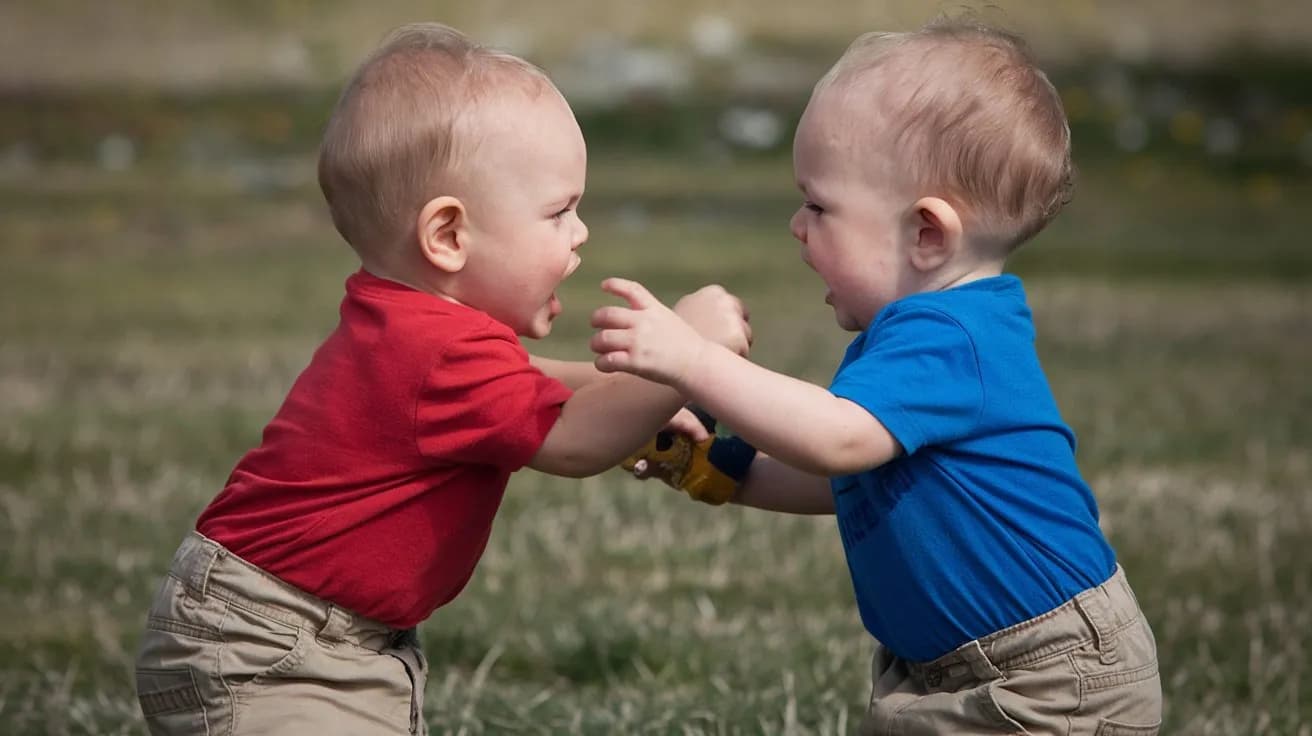
Twin Toddler Fights: When Sharing, Biting, and Hitting Is Normal and When It's Not
Twin toddlers fight. A lot. Here is how to tell the difference between normal developmental conflict and behavior that needs intervention.
If you have twin toddlers, they fight. This is not a parenting failure. It is what happens when two small humans with no impulse control, limited language, and identical taste in toys share every waking moment. The question for twin parents is not "how do I stop them from fighting" but "which fights are normal, which need intervention, and how do I keep everyone safe while their social brains develop."
What is normal (and why)#
Toddlers between 12 and 36 months are in the earliest stages of learning to share, take turns, and express frustration with words instead of actions. Twins are doing this in close quarters with a sibling who wants the exact same thing at the exact same time. Conflict is not just normal. It is the classroom.
Normal behaviors at this stage
- Grabbing a toy from the other twin's hands. Toddlers do not understand ownership or turn-taking yet. They see something, they want it, they take it.
- Pushing when another child is in their space. Toddlers have poor spatial awareness and even poorer frustration tolerance.
- Screaming or crying when a toy is taken. The emotional response is disproportionate because emotional regulation does not exist yet.
- Brief hitting or swatting during a conflict over an object. Impulsive, not planned. The toddler hits and then looks confused.
- Biting between 12 and 24 months. Biting at this age is a sensory and communication behavior, not aggression. The child is frustrated and does not have words. Biting is the fastest way they know to express "I want that" or "back off."
All of these behaviors peak between 18 and 30 months and decline as language improves. You do not need to "fix" normal developmental behavior. You need to manage it safely while it runs its course.
When it is not normal#
Some patterns go beyond typical toddler conflict and may need attention from a pediatrician or child development specialist.
- One twin consistently targets the other without provocation. If the same child is always the aggressor and the conflicts are not about a toy or a shared resource, the behavior may be beyond developmental norms.
- Biting that continues regularly past age 3. By age 3, most children have enough language to replace biting. Persistent biting after this age warrants a conversation with your pediatrician.
- Behavior that causes injury requiring medical attention. Toddler scuffles produce bumps and teeth marks. Behavior that breaks skin, leaves bruises, or causes head injuries is beyond normal conflict.
- One twin is consistently afraid of the other. If one child avoids the other, flinches at their approach, or is anxious in their presence, the dynamic needs professional evaluation.
- Aggression that occurs outside the twin pair too (at daycare, with other children, toward adults). If the behavior is not twin-specific, it may be a broader regulation issue.
How to intervene without making it worse#
The goal of intervention is safety first, teaching second. You are not going to teach a 20-month-old empathy through a lecture. You are going to keep both kids safe and plant seeds that grow over months.
In the moment
- Separate immediately if someone is hurt or about to be hurt. Pick up the hitter or biter calmly. No yelling.
- Comfort the hurt child first. This sends the message that hitting does not get attention. The comforting is also the teaching: the hurt child's pain is visible, and the other child sees it.
- Use simple, short language. "Hitting hurts. We don't hit." That is the entire message for a toddler. Do not explain why hitting is wrong. They cannot process the reasoning yet.
- Offer the alternative. "You can say 'mine' or 'my turn.'" Even if they cannot say it yet, you are modeling the replacement behavior.
- Do not force an apology. A coerced "sorry" from a 2-year-old teaches performance, not empathy. Modeling is better: "I see you hurt your brother. Let's check if he's okay."
Proactively
- Duplicate high-conflict items. If one specific toy causes 80% of the fights, buy a second one. This is not "giving in." It is removing a trigger while their brains develop the capacity to share.
- Create separate play zones within the same room. A small mat or corner that is "yours" gives each twin a space they control.
- Narrate social interactions. "You both want the truck. That's hard. Let's try turns. You hold it, then your sister holds it." You are the sportscaster of their social development.
- Praise cooperative play loudly and specifically. "You handed her the block! That was kind!" Attention reinforces behavior more effectively than correction.
The sharing myth#
Twin parents face enormous pressure to make their children share. But genuine sharing (voluntarily giving something to another person) is a developmental skill that emerges around age 3 to 4. Before that, what looks like sharing is usually compliance or disinterest.
Forcing a toddler to share before they are developmentally ready does not teach sharing. It teaches that their possessions are not secure, which often increases guarding behavior. A better approach: take turns with a timer, let each child have some things that are exclusively theirs, and model sharing in your own behavior.
When the fights are actually good#
This sounds counterintuitive, but twin toddler conflict is one of the most powerful social development tools available. Twins who fight also learn to negotiate, apologize (genuinely, around age 3 to 4), and read another person's emotions earlier than many singletons. The fights are the curriculum.
Your job is not to prevent all conflict. It is to keep both children physically safe while the conflict teaches them what you cannot teach with words alone.
Related reading#
FAQ
- Is it normal for twin toddlers to fight constantly?
- Yes. Two small humans with no impulse control and identical taste in toys share every waking moment; conflict is the classroom, not a parenting failure. Grabbing, pushing, disproportionate screaming, impulsive swatting, and biting between 12 and 24 months all peak around 18 to 30 months and decline as language arrives.
- When is twin toddler aggression not normal?
- When one twin consistently targets the other without provocation, biting continues regularly past age 3, injuries need medical attention, one twin is genuinely afraid of the other, or the aggression shows up everywhere (daycare, other kids, adults), not just inside the pair. Those patterns warrant a pediatrician or child development conversation.
- How do you break up a twin toddler fight?
- Safety first, teaching second: separate calmly without yelling, comfort the hurt child first (attention rewards the victim, not the hitter), keep the message short ("hitting hurts, we don't hit"), offer the replacement words ("say mine or my turn"), and skip the forced apology. A coerced sorry at 2 teaches performance, not empathy.
- Should you force twins to share?
- No. Genuine sharing emerges around age 3 to 4; forcing it earlier teaches that possessions are not secure and often increases guarding. What works: turns with a timer, some belongings that are exclusively each child's, duplicating the one toy that causes most of the fights, and loud specific praise when cooperation happens.
Keep reading
Related guides
Survival
Should Twins Be in the Same Class or Separate? What the Research Says
Every twin parent faces this question by age 4 or 5. Schools often have a default policy. The research says the answer depends on your specific twins, not a blanket rule.
Sep 11, 2026
Survival
Twin Childcare: Daycare vs Nanny vs Nanny Share vs Au Pair
Childcare is the single largest twin expense. Here is what each option actually costs, when each makes sense, and the hidden costs most guides skip.
Sep 11, 2026
Survival
NICU Survival Guide for Twin Parents
About half of twins spend time in the NICU. It is scary, it is common, and it usually ends well. Here is what to expect, what to pack, and how to get through it.
Sep 11, 2026