Twin Pregnancy Week by Week: What's Actually Different From Singletons
A no-fluff guide to the milestones, scans, and risk markers that genuinely diverge from a singleton pregnancy. Trimester by trimester, what matters and what doesn't.
Twin pregnancy is not a longer version of singleton pregnancy. Timelines, scans, weight gain, and risk markers all shift earlier or appear differently. Most pregnancy apps still tell you that term is 40 weeks. For twins, term is 37. Here's the actual week-by-week shift, focused only on what's genuinely different.
Chorionicity is the most important number#
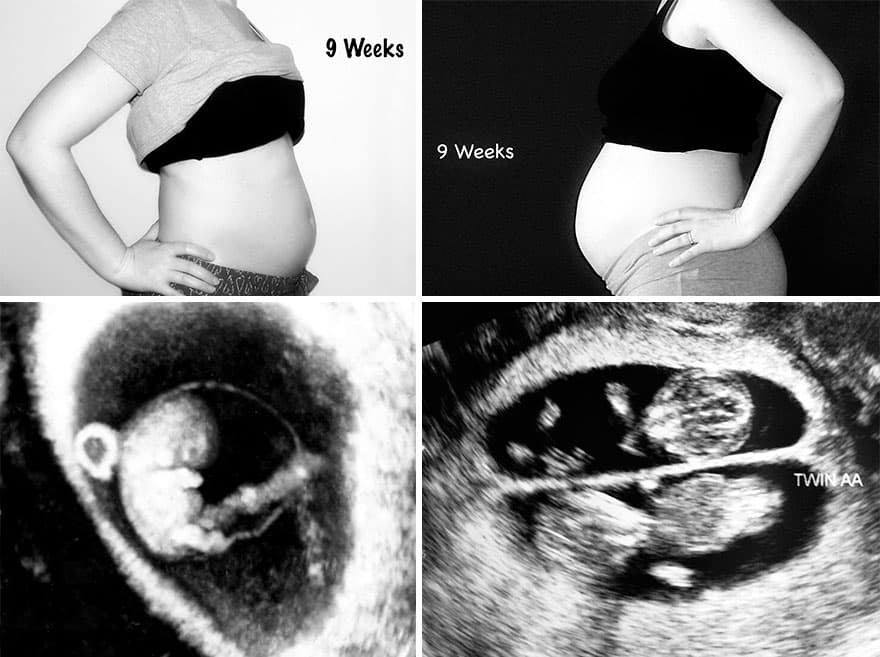
Your first-trimester scan should determine chorionicity. Whether your twins share a placenta, an amniotic sac, or have separate everything. This is the most consequential piece of information of the whole pregnancy, more than zygosity.
- Dichorionic-Diamniotic (DCDA): two placentas, two sacs. Lowest risk. All fraternal twins, plus ~1/3 of identical twins.
- Monochorionic-Diamniotic (MCDA): one placenta, two sacs. Higher monitoring frequency for TTTS. ~2/3 of identical twins.
- Monochorionic-Monoamniotic (MCMA): one placenta, one sac. Highest risk. Rare. Hospital admission is common from ~24 weeks.
The chorionicity scan should happen by week 14. Earlier is more accurate. Get it on the calendar and ask explicitly which type you have. Your monitoring schedule changes based on the answer.
First trimester (weeks 4–13)#
The first trimester looks similar to a singleton pregnancy from the outside, but symptoms typically arrive earlier and stronger.
- Morning sickness often starts earlier (~5 weeks) and is more intense. HCG levels are roughly double.
- Weight gain begins immediately. Twin targets are higher: typically 37–54 lb total for normal-BMI, by current obstetric guidance.
- A dating scan happens by week 8 in most regions.
- The chorionicity scan should happen by week 14.
What to ask your provider
- Chorionicity (see above).
- Whether they handle twin pregnancies regularly. If not, ask for a referral to a high-risk OB or maternal-fetal medicine specialist.
- Your specific weight-gain target.
Second trimester (weeks 14–27)#
Twin parents see far more of their provider in the second trimester than singleton parents. Plan around it.
- Anatomy scan around 18–22 weeks, same as singleton, but each baby is checked independently.
- Cervical length monitoring starts in twin pregnancies around 20 weeks. A short cervix is the strongest predictor of preterm labor.
- Gestational diabetes screening happens earlier in many regions for twins (~24 weeks instead of 26–28).
- Monthly OB visits typically become biweekly.
Risk markers worth knowing
- Twin-to-Twin Transfusion Syndrome (TTTS): only relevant for monochorionic twins. Monitored via biweekly ultrasound from ~16 weeks.
- Preterm labor signs: cramping, lower back pressure, regular tightening. Twins deliver early on average; before 34 weeks is a problem.
- Preeclampsia: blood pressure spikes, swelling, headaches. Twin pregnancy roughly doubles the baseline risk.
Third trimester (weeks 28–37)#
For singletons, the third trimester goes to 40+ weeks. For twins, term is 37. Many DCDA twins deliver between 36 and 38 weeks; MCDA often 36–37; MCMA often 32–34 by scheduled C-section.
This compresses the prep window. Your "I have months" buffer is more like weeks.
- Hospital bag should be packed by week 30, not 36.
- Childcare for older kids should be lined up by week 30.
- Car seat install and stroller setup should be done by week 32.
- A work handover plan should assume an earlier-than-expected start to leave.
How delivery actually goes
- DCDA: vaginal delivery is possible, often offered if Baby A is head-down. Many providers schedule a C-section if Baby A is breech.
- MCDA: vaginal possible but with closer fetal monitoring during delivery.
- MCMA: planned C-section, almost always.
What singleton guides get wrong about twins#
- "You can travel until 36 weeks." For twins, many providers cut travel at 28 weeks.
- "You'll feel kicks at 16 weeks." Often earlier with twins because there's less room.
- "Term is 40 weeks." Term for twins is 37.
- "One anatomy scan covers everything." Twin anatomy scans are longer; sometimes split across two appointments.
One thing that's actually easier#
Twin pregnancies are monitored more closely than singleton pregnancies. You'll see your provider often, get more scans, and have more data on each baby. If you find this reassuring rather than stressful, the increased frequency is a feature, not a cost.
The headline: twin pregnancy is shorter, more medically active, and front-loaded with decisions (chorionicity, monitoring schedule, delivery plan). Once you've made those, the rest is mostly logistics.
Related reading#
Mentioned in this guide
Featured picks

Some buy links earn us a small cut, at no extra cost to you. We still recommend skipping plenty of things, so it balances out.
FAQ
- What is full term for twins?
- 37 weeks, not 40. Many DCDA twins deliver between 36 and 38 weeks, MCDA often 36 to 37, and MCMA usually 32 to 34 by scheduled C-section. That compresses your prep window: hospital bag by week 30, car seats installed by week 32, and a work handover that assumes an early start.
- What is chorionicity and why does it matter?
- It is whether your twins share a placenta and sac, and it is the most consequential fact of the pregnancy. DCDA (two placentas, two sacs) is lowest risk. MCDA (shared placenta) needs biweekly ultrasounds for TTTS from around week 16. Get the scan by week 14 and ask explicitly which type you have.
- How is twin pregnancy monitoring different?
- More of everything. Anatomy scans check each baby independently and can split across two visits, cervical length monitoring starts around 20 weeks, gestational diabetes screening often comes earlier, and monthly OB visits typically become biweekly. If frequent data reassures you, this is the one part that is genuinely easier.
- What do singleton pregnancy guides get wrong about twins?
- The big ones: term is 37 weeks, not 40. Travel often gets cut at 28 weeks, not 36. Kicks can show up earlier because there is less room. And morning sickness tends to start earlier and hit harder, since HCG levels run roughly double.
Keep reading
Related guides
Survival
Should Twins Be in the Same Class or Separate? What the Research Says
Every twin parent faces this question by age 4 or 5. Schools often have a default policy. The research says the answer depends on your specific twins, not a blanket rule.
Sep 11, 2026
Survival
Twin Childcare: Daycare vs Nanny vs Nanny Share vs Au Pair
Childcare is the single largest twin expense. Here is what each option actually costs, when each makes sense, and the hidden costs most guides skip.
Sep 11, 2026
Survival
NICU Survival Guide for Twin Parents
About half of twins spend time in the NICU. It is scary, it is common, and it usually ends well. Here is what to expect, what to pack, and how to get through it.
Sep 11, 2026