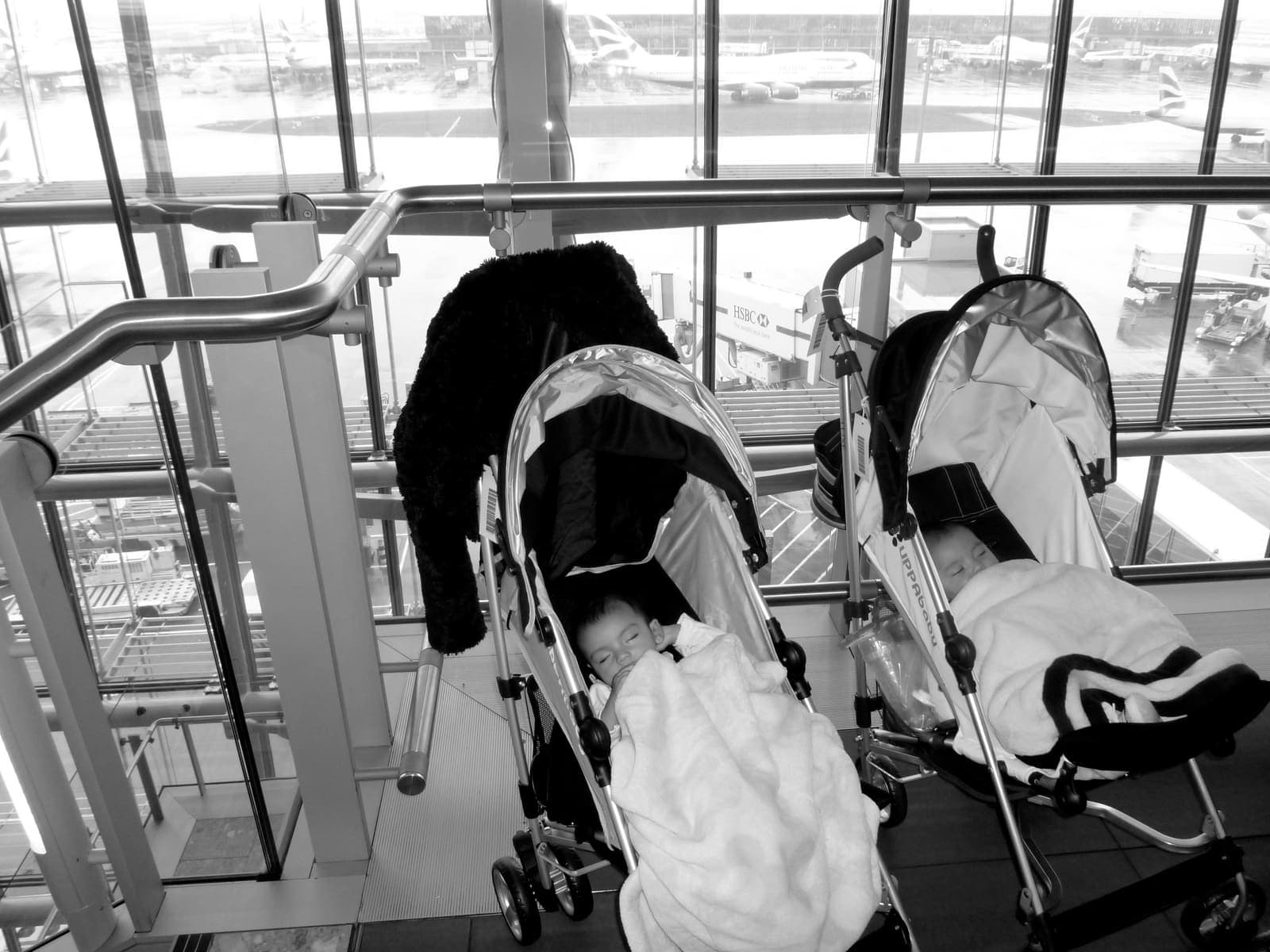
Flying With Twins: Airline Seat Math, Gate-Check Gear, and Survival Tips
One lap infant per adult, per row. That single rule shapes your entire flight plan. Here is the logistics guide for getting twins on and off a plane.
Flying with one baby is stressful. Flying with twins is a logistics operation that starts weeks before the flight. The central constraint is a rule most parents do not know until they try to book: most airlines allow only one lap infant per row. That single rule dictates your seat selection, your ticket count, and your entire boarding strategy.
The lap infant rule: why twin flights are different#
On most airlines (US and international), a lap infant is a child under 2 traveling on an adult's lap without a paid seat. The rule is one lap infant per adult, and critically, only one lap infant per row of seats on the aircraft. This is because each row has a limited number of supplemental oxygen masks.
- Two adults, two lap infants, same row: not allowed on most US carriers. Some international airlines (like Lufthansa) permit it under certain conditions, but do not count on it.
- Two adults, two lap infants, different rows: allowed. You sit in row 14, your partner sits in row 15. Each holds one baby.
- One adult, two lap infants: never allowed. You need a minimum of two ticketed adults.
The workaround: buy a seat for one baby (at child fare or full fare depending on the airline) and hold the other as a lap infant. This gives you three seats in one row for two adults and one baby, with the second baby in a car seat in the paid seat.
Seat selection strategy#
Once you understand the lap infant constraint, seat selection becomes a logistics puzzle:
- Bulkhead rows: more legroom, often where bassinet attachments (for international long-haul) are located. Request these early. Many airlines will not assign bulkhead to lap infants online; call the airline directly.
- Window plus middle: if you buy a seat for one baby (with a car seat), the window is safest. The other adult takes the middle or aisle with the lap infant.
- Adjacent rows: if both babies are lap infants, book the window seat in row 14 and the window seat in row 15 (same side). You can pass items between rows, and you are not separated by strangers.
- Avoid exit rows: lap infants are not allowed in exit rows.
Gate-checking twin gear: what goes and what stays#
Gate-checking means checking items at the aircraft door rather than at the ticket counter. For twin parents, this is where the logistics get real.
- Double stroller: gate-check. Most airlines accept one stroller per family at the gate. Use a gate-check bag to protect it. A side-by-side stroller in a gate-check bag fits through the jet bridge on most aircraft.
- Two car seats (if needed at destination): check at the ticket counter in car seat travel bags, or gate-check if you bought seats and are using them on the plane. Car seats on planes must be FAA-approved (look for the label).
- Car seat frames (Snap-and-Go style): gate-check. Lightweight and useful for getting two infant seats through the airport.
- Pack-and-plays for the destination: check as luggage. They count as baby equipment and most airlines allow them free.
Check your specific airline's policy before flying. Policies on free checked baby equipment vary. Most US carriers allow a stroller plus a car seat per child for free.
Airport logistics: a step-by-step plan#
Getting through the airport with two babies requires a plan that you walk through in advance.
- Check luggage curbside or at the counter. Get bags out of your hands immediately.
- Put both babies in the double stroller. This is the single best reason to own a double stroller: airport transit. Babywearing one while strolling the other also works if your stroller is single.
- TSA: baby food, breast milk, and formula in quantities over 3.4 ounces are permitted. Declare them at the X-ray machine. Expect them to be tested. This takes an extra 2 to 3 minutes.
- Diaper changes before boarding. Airport family restrooms are your friend. Change both babies after security and before boarding.
- Board early. Airlines with pre-boarding for families: use it. The 5 extra minutes to set up car seats, stow bags, and get settled is worth more than any other airport hack.
In-flight survival#
Once you are seated, the flight itself is manageable with preparation:
- Feed during takeoff and landing. Sucking (breast, bottle, or pacifier) helps with ear pressure. Time your bottles for these moments.
- Bring more diapers than you think. A standard rule: 1 diaper per baby per hour of total travel time (including layovers), plus 4 extras. For a 5-hour trip with two babies, that is 14 diapers.
- Pack a change of clothes for each baby and for each adult. Blowouts at altitude are a twin parent rite of passage.
- Bring new, small toys or books. Novel items hold attention longer than familiar ones. Dollar store items are perfect.
- Accept help from kind strangers. People on planes are generally nicer to twin parents than twin parents expect. Let someone hold a bottle or play peekaboo.
The flight age sweet spots#
Not all ages are equally flyable:
- Under 3 months: actually easier than you would expect. Babies sleep most of the flight. Feed and hold.
- 3 to 9 months: moderate difficulty. Babies are awake more, need entertainment, but cannot yet crawl away.
- 9 to 18 months: the hardest window. Mobile, curious, strong opinions, no patience. Avoid optional flights in this range if you can.
- 18 months to 2.5 years: improving. They can watch a screen, eat snacks, and sit still for short periods.
International flights: bassinet seats#
Many international carriers offer bassinets that attach to the bulkhead wall for babies under 20 to 25 pounds. For twins, this is transformative on long flights.
- Call the airline (do not rely on online booking) and request two bassinets side by side.
- Availability is limited. Book early and confirm at check-in.
- Not all aircraft have two bassinet positions in the same row. On some, they are in different cabins. Ask the airline which aircraft operates your route.
What we would do#
Book early. Call the airline to discuss lap infant rules for your specific route. Sit in adjacent rows if both babies are lap infants, or buy one seat and bring a car seat for the other baby. Gate-check the stroller. Feed during takeoff. Bring 50% more diapers than you think you need. And remember: the flight is temporary. Even the worst flight with twins ends when the wheels touch down.
Related reading#
FAQ
- Can two parents fly with two lap infants?
- Not in the same row on most carriers: the limit is one lap infant per row, driven by oxygen mask counts. The workarounds are adjacent rows (same side, one parent and baby per row) or buying a seat for one baby and flying them in an FAA-approved car seat. One adult with two lap infants is never allowed.
- What twin gear can you gate-check on a flight?
- The double stroller (in a gate-check bag; most airlines take one per family), car seat frames, and car seats if not used in a purchased seat. Pack-and-plays check as free baby equipment on most carriers. Policies vary, so confirm your airline's rules before flying.
- What age is hardest to fly with twins?
- 9 to 18 months: mobile, curious, opinionated, zero patience. Avoid optional flights in that window. Under 3 months is easier than expected (they sleep through most of it), 3 to 9 months is moderate, and from 18 months a screen and snacks start working in your favor.
- What are the top in-flight tactics for twins?
- Board early with family pre-boarding and use the setup time, feed during takeoff and landing for ear pressure, bring one diaper per baby per travel hour plus four extras, pack a change of clothes for every person including adults, and bring small novel toys. On long-haul international flights, call the airline for two side-by-side bulkhead bassinets; not every aircraft has them in one row.
Keep reading
Related guides
Survival
Should Twins Be in the Same Class or Separate? What the Research Says
Every twin parent faces this question by age 4 or 5. Schools often have a default policy. The research says the answer depends on your specific twins, not a blanket rule.
Sep 11, 2026
Survival
Twin Childcare: Daycare vs Nanny vs Nanny Share vs Au Pair
Childcare is the single largest twin expense. Here is what each option actually costs, when each makes sense, and the hidden costs most guides skip.
Sep 11, 2026
Survival
NICU Survival Guide for Twin Parents
About half of twins spend time in the NICU. It is scary, it is common, and it usually ends well. Here is what to expect, what to pack, and how to get through it.
Sep 11, 2026