Twin Sleep Regression Survival: When Both Regress at Once
Sleep regressions are hard with one baby. With twins, one regressing can trigger the other. Here is how to get through the 4-month, 8-month, and 12-month regressions without losing your mind.
Sleep regressions are a normal part of infant development. The brain is reorganizing, new skills are emerging, and sleep takes a temporary hit. With one baby, you power through. With twins, one baby's regression can wake the other, and suddenly you are back to the newborn chaos you thought you had escaped.
The twin-specific problem is not the regression itself. It is the cascade. Here is what to expect at each major regression and how to manage the domino effect.
The 4-month regression (the big one)#
Around 3.5 to 4.5 months, babies transition from newborn sleep cycles to adult-style sleep architecture. This is permanent and biological, not behavioral. Every baby goes through it. The question with twins is whether they go through it simultaneously.
What happens
- Wake-ups increase from 1 to 2 per night to 4 to 6.
- Naps shorten dramatically (the 30-minute nap trap).
- Settling takes longer. Babies who self-settled before may stop.
- If one twin hits it first, their night crying can trigger the other twin's wakeups even if that twin has not regressed yet.
Twin-specific tactics
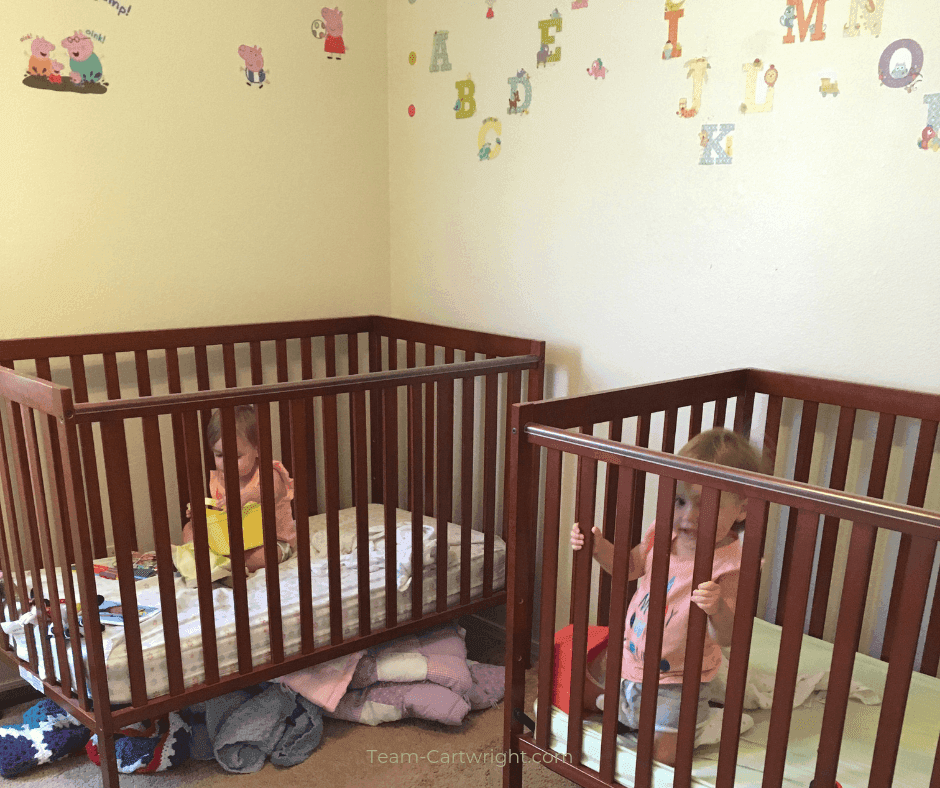
- White noise between cribs, volume at 55 to 60 dB. This is your best defense against the cascade.
- If one twin is regressing and the other is not, consider temporary room separation. Move the sleeping twin to a pack-n-play in another room for 1 to 2 weeks while the regressing twin works through it.
- Reintroduce the wake-the-other rule if both are waking anyway. Better to feed both at once than to handle staggered wakeups all night.
- Lower your expectations. The 4-month regression lasts 2 to 6 weeks. It ends. Sleep debt is temporary.
The 8-month regression#
This one is driven by cognitive and motor milestones: crawling, pulling up, separation anxiety. It is less universal than the 4-month regression but still common.
What happens
- Babies practice new skills in the crib (standing, crawling) instead of sleeping.
- Separation anxiety peaks. Babies cry when you leave the room.
- Night wakeups increase, often with genuine distress rather than just hunger.
Twin-specific tactics
- If one twin is pulling to stand in the crib and the noise wakes the other, lower the mattress immediately. A baby who can stand but not sit back down will cry longer.
- Separation anxiety affects each twin differently. One may be fine; the other may need more bedtime reassurance. Give it without guilt.
- Practice new motor skills aggressively during the day. Crawling practice, standing practice, sit-down-from-standing practice. Daytime mastery reduces nighttime rehearsal.
The 12-month regression#
Often triggered by the transition from two naps to one, combined with walking attempts and language bursts. This regression is shorter (1 to 3 weeks) but can be intense.
What happens
- Nap refusal, especially the morning nap.
- Bedtime resistance. Toddlers who used to settle easily start protesting.
- Early morning waking (4:30 to 5:30 AM).
Twin-specific tactics
- If one twin drops the morning nap and the other does not, stagger nap times. One naps while the other has floor time. This feels logistically painful but lasts only 2 to 4 weeks.
- Do not rush the two-to-one nap transition. Keep offering the morning nap until both twins refuse it consistently for 5 or more days.
- Early waking is often caused by overtiredness, not too much sleep. An earlier bedtime (6:30 PM) can paradoxically fix a 5 AM wake.
The cascade problem and how to break it#
The twin-specific nightmare is the cascade: one baby wakes, cries, wakes the other, and now you have two upset babies instead of one. Three approaches to break the cycle:
- White noise. Always the first lever. Raise it to 60 dB during regression weeks if needed.
- Temporary room separation. The most effective intervention when one twin is regressing hard and the other is sleeping fine. Move the sleeping twin out for a week or two.
- Fast response. During regressions, respond to the waking twin faster than usual. The goal is to soothe them before the crying escalates enough to wake the other. A 30-second response window beats a 5-minute one.
When to consider sleep training#
Many twin parents start thinking about formal sleep training during or after the 4-month regression. If you decide to try it, a few twin-specific notes:
- Train one twin at a time if possible. Separate rooms for 1 to 2 weeks while one twin learns to self-settle.
- If room separation is not possible, train both simultaneously. Choose a method (Ferber, chair method, extinction) and apply it to both. The first 3 nights will be loud.
- Consistency matters more with twins because inconsistency for one twin affects the other's sleep environment.
What we would do#
White noise at 55 to 60 dB, always. Temporary room separation during the worst regression weeks. Fast response to prevent cascades. Daytime skill practice to reduce nighttime rehearsal. And patience. Every regression ends. The twin-specific challenge is managing two timelines simultaneously, and accepting that some weeks both babies will sleep badly regardless of what you do.
Related reading#
FAQ
- Do twins go through sleep regressions at the same time?
- Not always, and that is the twin-specific problem. The 4-month regression is universal and biological, but one twin can hit it weeks before the other, and the regressing baby's night crying wakes the twin who was sleeping fine. The battle is managing two timelines plus the cascade between them.
- How do you handle the 4-month sleep regression with twins?
- White noise between the cribs at 55 to 60 dB is the best cascade defense. If one twin regresses and the other does not, move the sleeping twin to a pack-n-play in another room for a week or two. If both wake anyway, go back to feeding both at once. It lasts 2 to 6 weeks and it ends.
- Can you sleep train twins?
- Yes. Train one twin at a time in separate rooms for a week or two if you can. If separation is not possible, train both simultaneously with one method applied consistently to both; the first three nights will be loud. Consistency matters more with twins because one baby's wake-ups are the other's sleep environment.
- Why are twins suddenly waking at 5am around 12 months?
- Usually overtiredness from the two-to-one nap transition, not too much sleep. Do not rush the transition: keep offering the morning nap until both twins refuse it consistently for five days, stagger naps if one drops it first, and try an earlier bedtime (around 6:30pm), which paradoxically fixes many 5am wake-ups.
Keep reading
Related guides
Survival
Should Twins Be in the Same Class or Separate? What the Research Says
Every twin parent faces this question by age 4 or 5. Schools often have a default policy. The research says the answer depends on your specific twins, not a blanket rule.
Sep 11, 2026
Survival
Twin Childcare: Daycare vs Nanny vs Nanny Share vs Au Pair
Childcare is the single largest twin expense. Here is what each option actually costs, when each makes sense, and the hidden costs most guides skip.
Sep 11, 2026
Survival
NICU Survival Guide for Twin Parents
About half of twins spend time in the NICU. It is scary, it is common, and it usually ends well. Here is what to expect, what to pack, and how to get through it.
Sep 11, 2026